

Chords and strumming
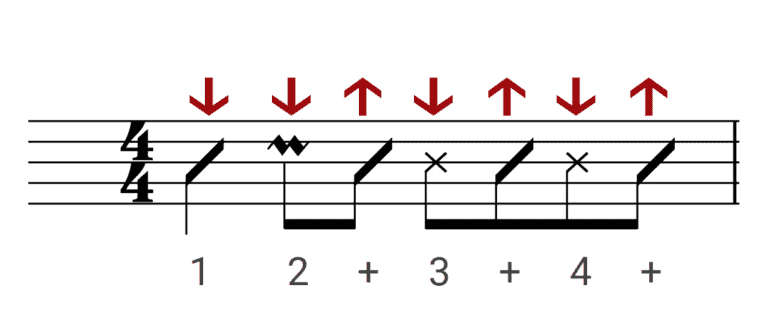
The island strum is a steady down-up motion with a rake on beat 2 and palm mutes on beats 3 and 4. It’s one of my favorite strums for songs with an island or Latin feel.
It isn’t the strum I use most, but I love the groove, and it adds color to songs I’d otherwise play with a straight down-up strum. I use it on I Can See Clearly Now. It doesn’t fit everything, so learn it, then try it with a few songs. I’ll build it step by step.

The Chords
You’ll practice on two chords, G and C. I use a four-finger G: first finger on the fifth string at the second fret, second finger on the sixth string at the third fret, and third finger and pinky on the second and first strings at the third fret. From there, move your first and second fingers down one string each for Cadd9, which I use in place of C. Your third finger and pinky stay put.
That’s optional. A regular G and C work fine, since this lesson is about the strum. The chords are at 1:07.
Step 1: The Pendulum Motion
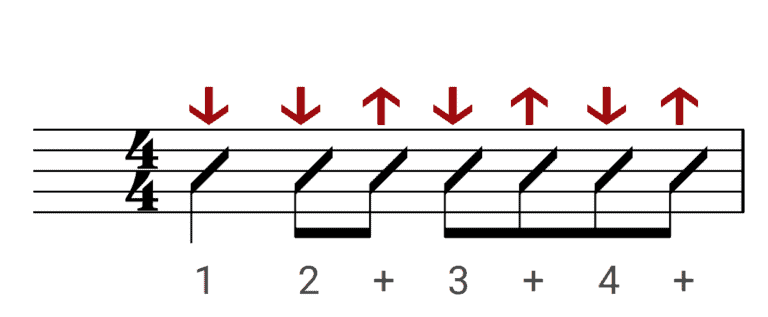
Your strumming hand moves down and up the whole time, like a pendulum. Sometimes you hit the strings and sometimes you pass over them. The pattern is down, skip, down-up, down-up, down-up, counted “1 (and) 2 and 3 and 4 and.” Practice it on G until it feels comfortable. Step 1 is at 2:27.
Step 2: The Palm Mute
A palm mute dampens the strings with your strumming hand as you strum, so you hear a muted version of the chord. Rest the side of your palm on the strings just next to the bridge, not on top of it, and strike down at the same time. Practice it first with your fretting hand lying across the strings, without a chord. The palm mute is at 3:58.
Here’s a good exercise: make a chord, mute on the way down, then let the chord ring on the way up. That’s a strum in its own right; it’s the one in Ob-La-Di, Ob-La-Da by the Beatles. If the mute doesn’t come right away, practice it a little each day for a week or two. It’s one of the most useful strumming techniques there is.
Step 3: Add the Mutes
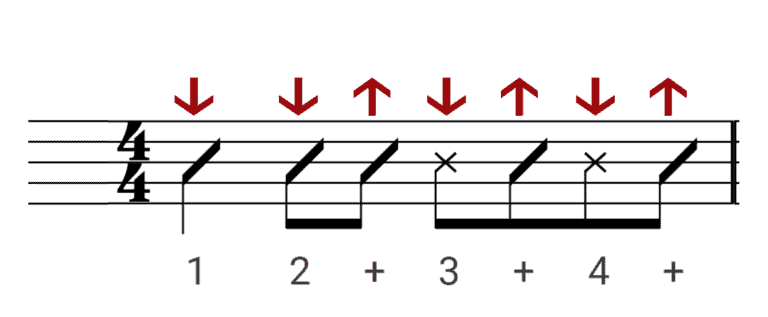
Keep the pattern from step 1, and mute the down strums on beats 3 and 4: down, skip, down-up, mute-up, mute-up. Start slowly, then try two in a row. I call this the double-mute strum. It works for a lot of pop and rock, so it’s a useful strum on its own. Step 3 is at 6:28.
Step 4: The Rake
A rake is a slower strum, so you hear each string, like a rake across the strings. Too slow, though, and it stops sounding like a strum and becomes an arpeggio. Start the rake a little early so you reach the bottom right on the beat. Practice it as down, rake-up: down on 1, rake on 2, up on the and. Step 4 is at 8:51.
Step 5: The Island Strum
Put it all together: down on 1, rake on 2 with an up after it, then mute-up on 3 and mute-up on 4. Play it with me at 9:29.
Take each part at your own pace, from the down-up motion to the mute and the rake. Once it’s second nature, it adds a lot of spice to your strumming. Try it on my I Can See Clearly Now lesson.
Want more lessons like this one? Try Real Guitar Success free for 14 days.